Many organisations have invested significant time and effort in AI governance frameworks, risk assessments and management systems. Yet one question remains: how do you demonstrate that your AI activities are being managed in a way that satisfies the specific regulatory expectations of the EU AI Act? This is where EN 18286 comes in.
Published as the European standard for Artificial Intelligence Quality Management Systems for EU AI Act regulatory purposes, EN 18286 provides a structured management system designed to support organisations in meeting regulatory obligations for AI systems, particularly high-risk AI systems demonstrating compliance for Article 17 of the Act which requires providers of high-risk AI systems to establish a quality management system. This quality management system must cover the organisation’s strategy, governance, risk management, data management, technical documentation, testing, monitoring, corrective actions, incident reporting and post-market controls needed to ensure ongoing compliance with the Act. It is intended primarily for organisations that place AI systems on the market or put them into service within the European Union, regardless of their size, sector or location. Importantly, it also applies to organisations outside the EU if their AI systems are made available in the European market.
At first glance, EN 18286 will feel familiar to anyone who has implemented ISO 9001 or ISO 42001. The structure follows a PDCA system model, The Plan-Do-Check-Act model is a continual improvement cycle used in management system standards.
In the context of EN 18286, this means AI governance and compliance are not treated as one-off activities, but as an ongoing cycle of planning, operation, monitoring, review and improvement across the AI system lifecycle.
Alignment with ISO 9001 and ISO/IEC 42001
In fact, the standard includes correspondence tables showing alignment with both ISO 9001 and ISO 42001
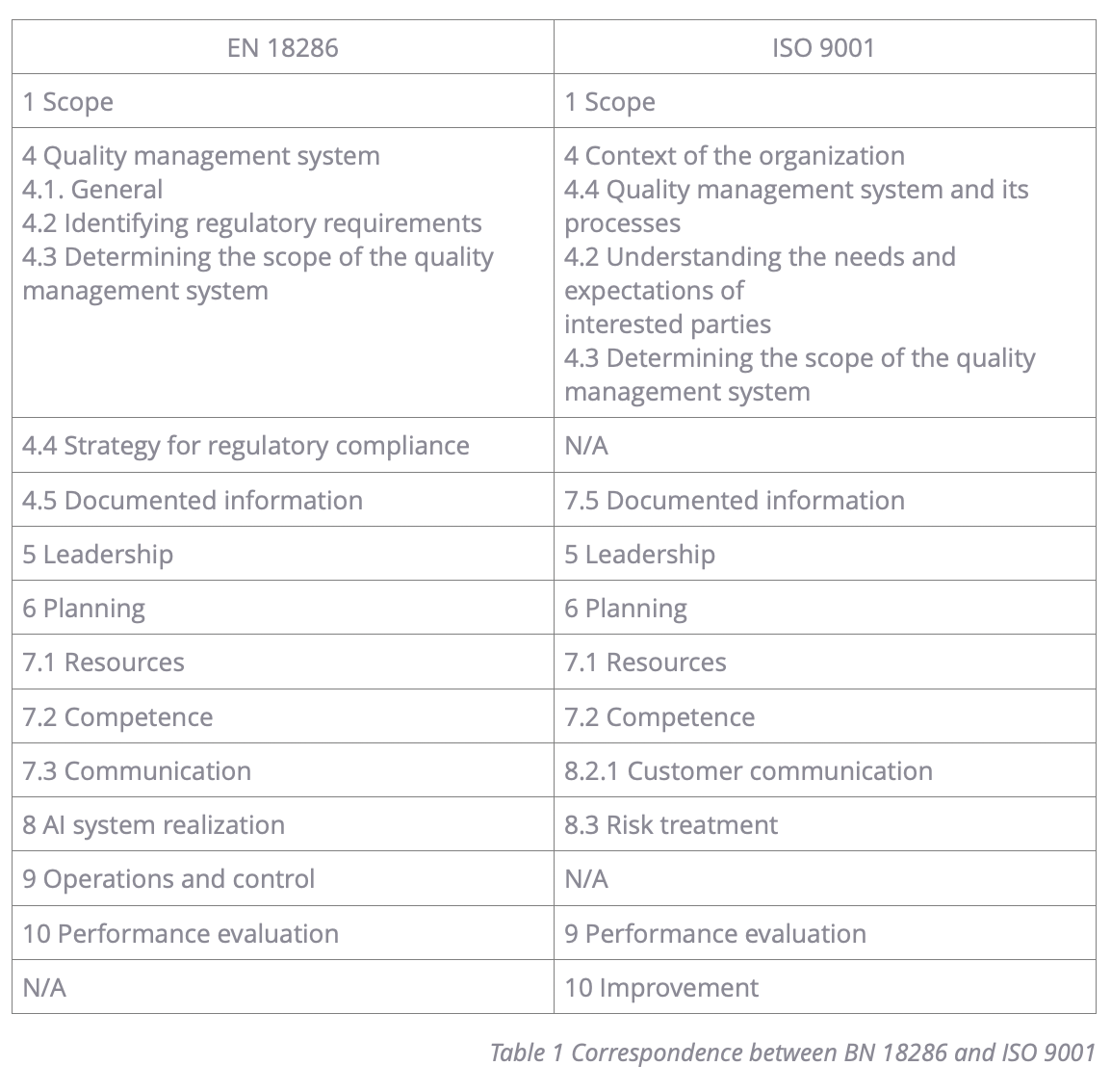
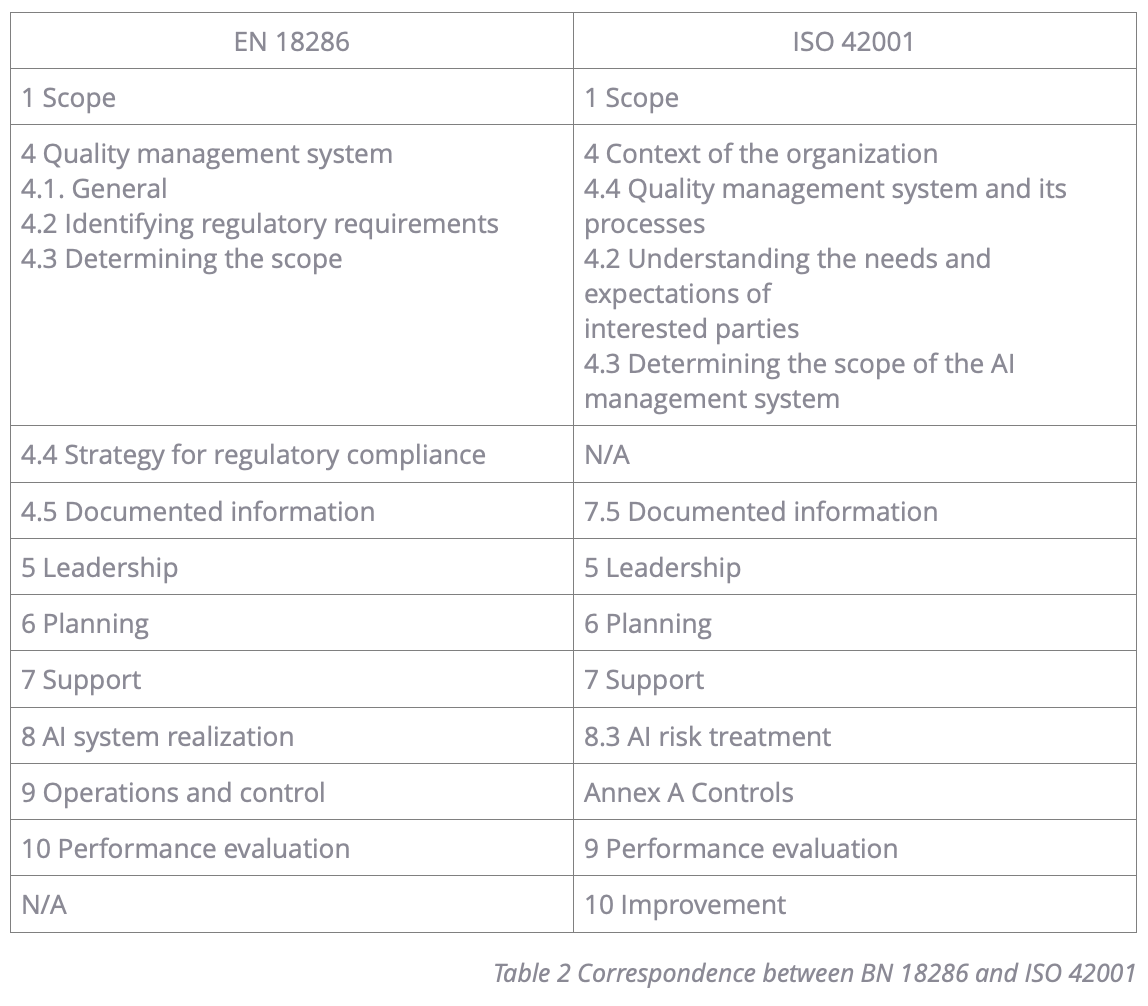
Organisations that already operate either of these standards will find many concepts transferable and potentially reusable.
However, EN 18286 is not simply another quality standard. Its purpose is fundamentally different.
ISO 9001 focuses on customer satisfaction and organisational quality. ISO/IEC 42001 focuses on establishing an AI management system that enables responsible governance of AI. EN 18286, by contrast, defines quality in terms of regulatory compliance. Throughout the standard, "quality" is linked directly to meeting regulatory requirements and protecting health, safety and fundamental rights.
This shift in emphasis drives several unique requirements. EN 18286 requires organisations to establish a regulatory compliance strategy, identify applicable legal requirements, implement lifecycle controls for AI systems, maintain technical documentation, manage post-market monitoring, investigate serious incidents, control modifications and continuously assess compliance after deployment. It also places strong emphasis on demonstrating traceability, verification, validation, risk management and oversight throughout the entire AI lifecycle.
The standard also extends beyond traditional governance by introducing specific requirements relating to deployers, affected persons, fundamental rights, regulatory authorities and market surveillance obligations. This reflects the EU AI Act's objective of protecting people from harms arising from AI systems while ensuring accountability from providers.
For organisations preparing for the EU AI Act, EN 18286 may become one of the most important standards to understand. Annex ZA explicitly maps the standard to EU AI Act requirements and states that, once referenced in the Official Journal of the European Union, conformity with applicable clauses can provide a presumption of conformity with corresponding regulatory requirements. However, the standard is clear that implementing EN 18286 alone does not automatically guarantee compliance with the EU AI Act. Regulatory obligations must still be assessed and addressed individually.
The key takeaway is simple: ISO 9001 provides quality management, ISO/IEC 42001 provides AI governance, but EN 18286 provides the bridge between AI management practices and demonstrable EU AI Act regulatory compliance. For organisations developing, supplying or operating high-risk AI systems, it is likely to become a critical component of their compliance strategy in the years ahead.
Get in touch to discuss information security and specialist assurance support
Kent: 01892 800476 | London: 02037 458 476 | info@avisoconsultancy.co.uk