

ISO 9001:2026 and ISO 14001:2026 Transition: What Certification Bodies Are Telling US
A practical UK guide to transition audits, additional time, costs and timelines
Updated: 6 October 2026
ISO 9001:2026 and ISO 14001:2026 are now published. For most certified organisations, transition should be a focused update to an existing management system, not a rebuild.
The concern is cost. Certification bodies are taking different approaches to extra fees, audit time and scheduling, so we asked several providers what clients should expect.
Our view: the revisions are limited and much of the intent should already be covered by a mature system. Transition should normally fit within scheduled surveillance or recertification and, where applicable, existing service agreements. Any additional fee or audit time should be justified and proportionate.
Important: Plans may change as accreditation and auditor training progress. Confirm current arrangements with your certification body.
The official UKAS position and transition timelines
UKAS has published the transition arrangements and assessment timetable that apply to UKAS accredited certification bodies, aligned where applicable with Global ACI transition requirements.
Key UKAS dates:
- ISO 14001:2026: certification body transition decisions completed by 30 April 2027; Certification bodies must stop accepting new applications to ISO 14001:2015. 18 months after publication of ISO 14001:2026 and must stop all new certifications to ISO 14001:2015 by 31 October 2027.; all certified customers transitioned by 30 April 2029.
According to UKAS, ISO 14001:2026 introduces revised environmental terminology, stronger emphasis on environmental performance, greater focus on evidence and documented information, strengthened control of external providers and improved clause linkage and traceability throughout the standard.
- ISO 9001:2026: certification body transition decisions completed by 30 September 2027; no new applications to the previous edition after 16 March 2028; all certified customers transitioned by 30 September 2029.
UKAS describes ISO 9001:2026 as a targeted revision rather than a fundamental rewrite. The most significant changes relate to:
• Interested parties
• Quality culture and ethical behaviour
• Risks and opportunities
• Planning of changes
• Management review
Certification bodies can issue UKAS accredited certificates to the new editions only after their own transition is approved. This is why their client start dates differ.
Prepare early, but keep the response proportionate: focused gap analysis, selective updates, awareness, internal audit and management review.
UKAS technical guidance
UKAS has published separate technical bulletins explaining the transition arrangements for ISO 9001:2026 and ISO 14001:2026. These documents are primarily written for accredited certification bodies but also provide useful information for certified organisations about the official timelines, accreditation process and restrictions on issuing accredited certificates to the revised standards.
• UKAS ISO 9001:2026 Transition Technical Bulletinhttps://www.ukas.com/resources/technical-bulletins/qms-iso-9001-2026-transition/
• UKAS ISO 14001:2026 Transition Technical Bulletinhttps://www.ukas.com/resources/technical-bulletins/ems-iso-14001-2026-transition/
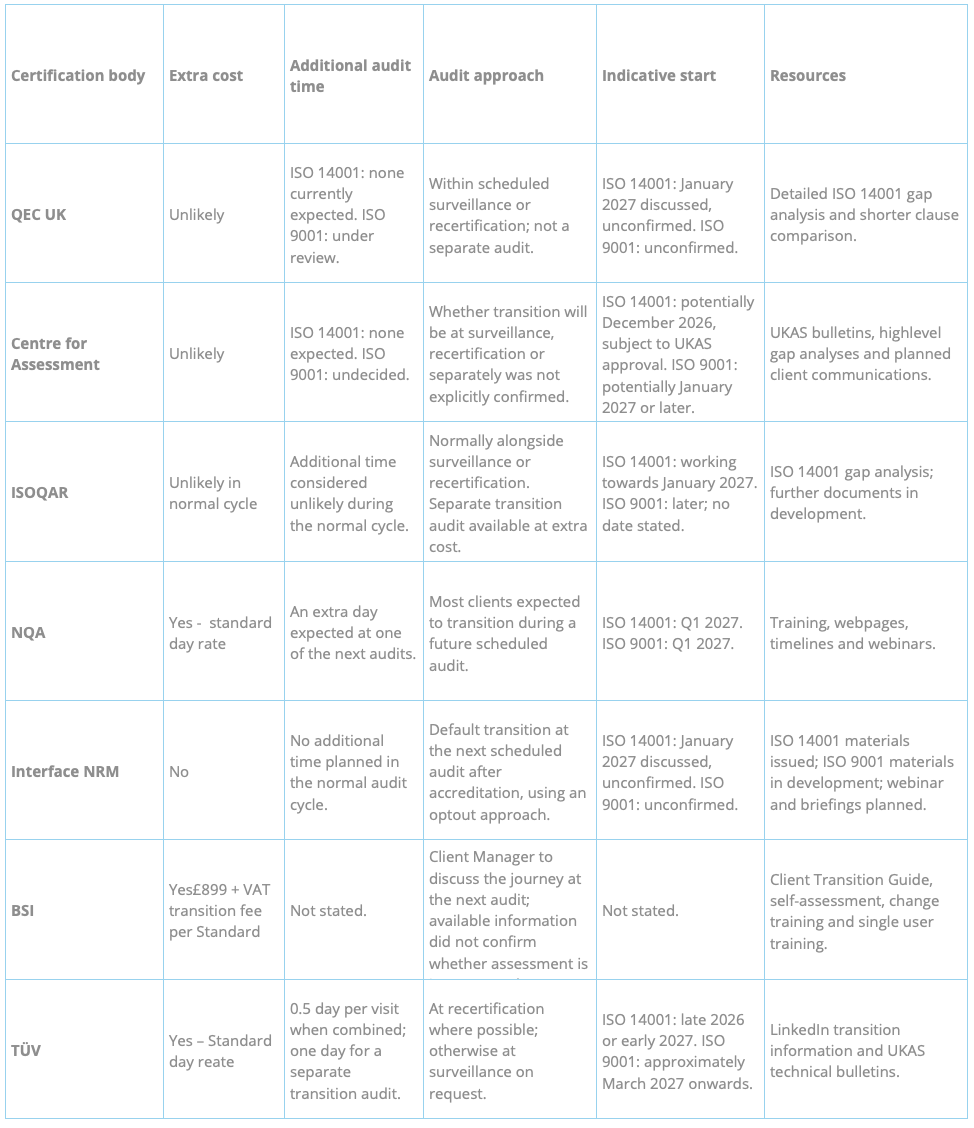
Certification body transition plans compared
This summary reflects information gathered by Aviso Consultancy and available at the time of writing. It is not a contractual quotation.
Why do the approaches differ?
The destination is fixed, but delivery varies. Differences may reflect accreditation timing, contracts, scheduling, system complexity and whether transition is combined with surveillance or recertification.
Different does not mean wrong, but extra fees and audit time should be explained clearly.
The key questions to ask your certification body
- When can you issue UKAS accredited certification to the new editions?
- Will transition be combined with surveillance or recertification?
- What extra time or fees apply, and why?
- What evidence and final completion date do you require?
- Can ISO 9001 and ISO 14001 transitions be coordinated?
A sensible, low disruption transition plan
- Review the final standards and complete a focused gap analysis.
- Update only what is needed and assign owners and dates.
- Build awareness around changes relevant to each role.
- Test readiness through internal audit and management review.
- Confirm arrangements in writing, including timing, fees and corrective action deadlines.
Use existing improvement and assurance cycles wherever possible. The objective is effective conformity, not more paperwork.
Final perspective
These transitions matter, but they should remain proportionate. Current approaches range from no extra cost or time to additional days and specific fees.
Understand the changes, ask for a clear rationale behind any additional charge and leave enough time to close findings. Improve what exists rather than rebuilding it.
Aviso Consultancy can support gap analysis, transition planning, internal audit and management review preparation.

-Updatet.jpg)


